Do you remember those days' horror?
2014年6月7日 星期六

2014年6月5日 星期四
2014年5月31日 星期六
Chinese Medicine
I myself love ginger tea soothing against freezing days. During hard time of flu I cook lemon and ginger with coca-cola to relieve myself. My friends consider it ' post-modern Chinese Medicine '. :P
It was a related news I read.
http://www.theepochtimes.com/n3/705198-a-first-appointment-for-chinese-medicine-and-acupuncture/
Many people are unfamiliar with Traditional Chinese Medicine and acupuncture. They want to know what to expect when they go to see a Chinese Medicine practitioner for the first time. So I am going to tell you! I write based on my own practice and I’m sure customs vary, depending on your acupuncturist, but this post will give you a good general overview.
It was a related news I read.
http://www.theepochtimes.com/n3/705198-a-first-appointment-for-chinese-medicine-and-acupuncture/
Many people are unfamiliar with Traditional Chinese Medicine and acupuncture. They want to know what to expect when they go to see a Chinese Medicine practitioner for the first time. So I am going to tell you! I write based on my own practice and I’m sure customs vary, depending on your acupuncturist, but this post will give you a good general overview.
When a new patient comes to see me, I ask them to come 10-15 minutes early to fill out paperwork, have eaten something beforehand and, if possible, to wear comfortable clothing (I do have gowns and towels at the office, if needed).
Some of the questions included in the initial paperwork include: What is your main complaint? How much caffeine do you consume? What supplements and/or medications are you taking? What is your energy level? How often do you have a bowel movement? Do you prefer foods that are cold or hot? I also have several sections where people can check off specific concerns that apply to them.
Once the paperwork is done we go back to the treatment room and I ask even more questions. I will also look at your tongue and take your pulses (find out more about pulse diagnosis with the link). Then, I usually have some lifestyle and dietary suggestions. For example, one very common suggestion I make (and have written about several times on my blog) is to drink ginger tea because it is simple and very helpful for such a wide variety of problems.
I give each patient a brief explanation of how their complaints are seen through the philosophy of Chinese Medicine. I explain treatment options, for example, acupuncture, herbal supplements and cupping. Almost all of my patients receive acupuncture, and many also enjoy the benefits of cupping and herbs. One general rule is: the longer a problem has been bothering you, the more treatment you will need to diminish it. So, if you’re coming in for a recent sinus infection, a couple of treatments and some herbs should get you feeling better quickly. However, if it is a longstanding pain like sciatica and it has been plaguing you for a year, you may feel relief after the first appointment, but will probably need several treatments to sustain the results. To those who are new to acupuncture, I explain that while the needle insertion is not usually painful, I do like to get some sensation once the needle is inserted. It feels different to different people and in different spots, but most do not mind it and it makes the treatments more effective.
Once the needles are in place and my patient is comfortable. I dim the lights, play relaxing music and leave them in for 20-50 minutes depending on the patient and the problem. I usually check on my patients while their needles are in and often re-stimulate the needles during the treatment. I am never far away and people can always call out to me. The majority of my patients find the treatments very relaxing and look forward to coming in.
Some of the questions included in the initial paperwork include: What is your main complaint? How much caffeine do you consume? What supplements and/or medications are you taking? What is your energy level? How often do you have a bowel movement? Do you prefer foods that are cold or hot? I also have several sections where people can check off specific concerns that apply to them.
Once the paperwork is done we go back to the treatment room and I ask even more questions. I will also look at your tongue and take your pulses (find out more about pulse diagnosis with the link). Then, I usually have some lifestyle and dietary suggestions. For example, one very common suggestion I make (and have written about several times on my blog) is to drink ginger tea because it is simple and very helpful for such a wide variety of problems.
I give each patient a brief explanation of how their complaints are seen through the philosophy of Chinese Medicine. I explain treatment options, for example, acupuncture, herbal supplements and cupping. Almost all of my patients receive acupuncture, and many also enjoy the benefits of cupping and herbs. One general rule is: the longer a problem has been bothering you, the more treatment you will need to diminish it. So, if you’re coming in for a recent sinus infection, a couple of treatments and some herbs should get you feeling better quickly. However, if it is a longstanding pain like sciatica and it has been plaguing you for a year, you may feel relief after the first appointment, but will probably need several treatments to sustain the results. To those who are new to acupuncture, I explain that while the needle insertion is not usually painful, I do like to get some sensation once the needle is inserted. It feels different to different people and in different spots, but most do not mind it and it makes the treatments more effective.
Once the needles are in place and my patient is comfortable. I dim the lights, play relaxing music and leave them in for 20-50 minutes depending on the patient and the problem. I usually check on my patients while their needles are in and often re-stimulate the needles during the treatment. I am never far away and people can always call out to me. The majority of my patients find the treatments very relaxing and look forward to coming in.
2014年4月8日 星期二
The Fight Against Cancer Just Took an Innovative Turn
from: http://www.huffingtonpost.ca/yanick-labrie/cancer-fighting-therapy_b_5558667.html
The Fight Against Cancer Just Took an Innovative Turn
Posted: 07/04/2014 5:18 pm
Follow


At an important conference in Chicago last June, over 25,000 doctors and researchers from around the world gathered to hear about several new breakthroughs in targeted therapies that will soon play a leading role in the fight against cancer.
These innovations will increasingly allow doctors to prescribe made-to-measure drugs that take individual patients' genetic profiles into account. By attacking cancerous cells more directly, these treatments significantly improve patients' chances of survival, all while reducing toxicity risks and other side effects associated with the taking of medication.
This is a promising new sector in the field of pharmacology, but this kind of innovation has been going on for some time. The arrival on the market of the drug Gleevec in 2001, for instance, revolutionized the battle against leukemia (CML), a disease that used to be highly lethal. Leukemia patients rarely survived much longer than three to six years. Nowadays, thanks to new, personalized treatments, a patient with this disease can expect to live over 25 years.
These innovations are the result of the combined efforts of university researchers and those of the pharmaceutical industry over several years. As documented by historian and oncologist Siddhartha Mukherjee in his Pulitzer Prizewinning work, the advent of chemotherapy and the pharmacological progress that took place during the second half of the 20th century gradually led to substantial gains in the battle against cancer.
Today, cancer drugs are the ones that most attract the attention of pharmaceutical companies. Nearly three times as many innovative oncological drugs were developed between 1990 and 2009 as were launched between 1970 and 1989. Within a period of a few years, a modest initiative primarily financed with public funds became a veritable armada involving thousands of companies and hundreds of billions of dollars of private investment.
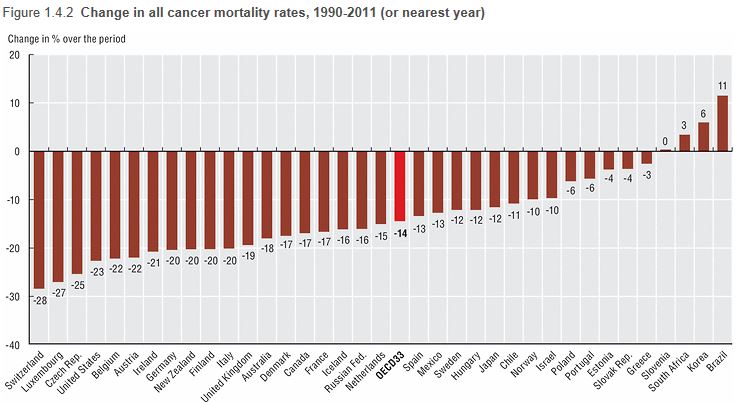
These efforts are starting to bear fruit. While it is true that the number of cancer cases in Canada has doubled over the past 25 years, this is mainly due to demographic growth and the aging of the population, not to an increase in cancer risk. In other words, we're living longer and are therefore more prone to cancer because we're not dying of other causes. Since the early 1990s, the age-adjusted cancer mortality rate has been falling in industrialized countries and in much of the rest of the world as well.
Economist Frank Lichtenberg of Columbia University recently looked into the connection between pharmaceutical innovation and mortality rates for some 60 types of cancer. For the 1990-2009 period, he found that the use of new drugs was responsible for nearly 60 per cent of observed reductions in cancer-related mortality rates.
It is without a doubt in the treatment of cancers afflicting children that the most remarkable advances have been made. Since the early 1970s, the mortality rates for these types of cancer have fallen by 3 per cent a year on average in Canada, the United States, Australia and Japan, in large part thanks to pharmacological treatments that were developed and made accessible during this period. Today, over 70 per cent of childhood cancer cases that occur in industrialized countries are cured.
The pharmaceutical industry is often the target of multiple attacks, yet it is partially responsible for the growing number of people who are now able to live both longer and also healthier lives than ever before.
Without pretending that every condition can be treated with drugs or that prevention and other factors are not also important, we must recognize that pharmaceutical research and the therapeutic progress it has entailed continue to be of enormous service to patients.
Yanick Labrie, is the author of "How Pharmaceutical Innovation Has Revolutionized Health Care"
2014年2月12日 星期三
The surprising story of medical marijuana and pediatric epilepsy: Josh Stanley at TEDxBoulder
Josh will sift through the propaganda, fear and greed encompassing medical marijuana. Recently featured on CNN, Josh and his brothers developed a non-psychotropic strain of marijuana which is drastically reducing seizures for many pediatric epilepsy patients in Colorado. With millions facing life-threatening illnesses, Josh outlines the hurdles needed to effect social change and maps a path toward helping those who desperately need revolutionary medicine.
Videography credits
Jenn Calaway, Enhancer
Michael Hering, Lodo Cinema
Sarah Megyesy, Side Pocket Images
Satya Peram, Flatirons Films
Sean Williams, RMO Films
Anthony Lopez, Cross Beyond
David Oakley
2013年12月13日 星期五
2013年11月2日 星期六
Is Your Calcium Supplement Killing You?
from: https://www.youtube.com/watch?v=hLP3SnbQvEc
http://www.drberg.com/body-type-quiz?...
Take the Body Type Quiz
http://www.drberg.com?utm_source=yout...
Dr. Eric Berg DC discusses the dangers of taking calcium carbonate. You would be better chewing on the cement on driveway. Our body is not meant to absorb rocks.
http://www.peoplespharmacy.com/2013/0...
http://thechart.blogs.cnn.com/2012/05...
Calcium does not do much for bones
http://www.nejm.org/doi/pdf/10.1056/N...
Grant AM, Avenell A, Campbell MK, McDonald AM, MacLennan GS, McPherson GC, Anderson FH, Cooper C, Francis RM, Donaldson C, Gillespie WJ, Robinson CM, Torgerson DJ, Wallace WA; RECORD Trial Group. "Oral vitamin D3 and calcium for secondary prevention of low-trauma fractures in elderly people (Randomised Evaluation of Calcium Or vitamin D, RECORD): a randomised placebo-controlled trial." Lancet. 2005 May 7-13;365(9471):1621-8.
Tang BM, Eslick GD, Nowson C, Smith C, Bensoussan A. "Use of calcium or calcium in combination with vitamin D supplementation to prevent fractures and bone loss in people aged 50 years and older: a meta-analysis." Lancet. 2007 Aug 25;370(9588):657-66.
Calcium Increase Heart Attacks
Abstract Title:
Calcium supplements with or without vitamin D and risk of cardiovascular events: reanalysis of the Women's Health Initiative limited access dataset and meta-analysis.
Abstract Source:
BMJ. 2011;342:d2040. Epub 2011 Apr 19. PMID: 21505219
Abstract Author(s):
Mark J Bolland, Andrew Grey, Alison Avenell, Greg D Gamble, Ian R Reid
Article Affiliation:
Department of Medicine, University of Auckland, Private Bag 92 019, Auckland 1142, New Zealand.
Abstract:
OBJECTIVES: To investigate the effects of personal calcium supplement use on cardiovascular risk in the Women's Health Initiative Calcium/Vitamin D Supplementation Study (WHI CaD Study), using the WHI dataset, and to update the recent meta-analysis of calcium supplements and cardiovascular risk.
DESIGN: Reanalysis of WHI CaD Study limited access dataset and incorporation in meta-analysis with eight other studies. Data source WHI CaD Study, a seven year, randomised, placebo controlled trial of calcium and vitamin D (1g calcium and 400 IU vitamin D daily) in 36,282 community dwelling postmenopausal women. Main outcome measures Incidence of four cardiovascular events and their combinations (myocardial infarction, coronary revascularisation, death from coronary heart disease, and stroke) assessed with patient-level data and trial-level data.
RESULTS: In the WHI CaD Study there was an interaction between personal use of calcium supplements and allocated calcium and vitamin D for cardiovascular events. In the 16,718 women (46%) who were not taking personal calcium supplements at randomisation the hazard ratios for cardiovascular events with calcium and vitamin D ranged from 1.13 to 1.22 (P = 0.05 for clinical myocardial infarction or stroke, P = 0.04 for clinical myocardial infarction or revascularisation), whereas in the women taking personal calcium supplements cardiovascular risk did not alter with allocation to calcium and vitamin D. In meta-analyses of three placebo controlled trials, calcium and vitamin D increased the risk of myocardial infarction (relative risk 1.21 (95% confidence interval 1.01 to 1.44), P = 0.04), stroke (1.20 (1.00 to 1.43), P = 0.05), and the composite of myocardial infarction or stroke (1.16 (1.02 to 1.32), P = 0.02). In meta-analyses of placebo controlled trials of calcium or calcium and vitamin D, complete trial-level data were available for 28,072 participants from eight trials of calcium supplements and the WHI CaD participants not taking personal calcium supplements. In total 1384 individuals had an incident myocardial infarction or stroke. Calcium or calcium and vitamin D increased the risk of myocardial infarction (relative risk 1.24 (1.07 to 1.45), P = 0.004) and the composite of myocardial infarction or stroke (1.15 (1.03 to 1.27), P = 0.009).
CONCLUSIONS: Calcium supplements with or without vitamin D modestly increase the risk of cardiovascular events, especially myocardial infarction, a finding obscured in the WHI CaD Study by the widespread use of personal calcium supplements. A reassessment of the role of calcium supplements in osteoporosis management is warranted.
Calcium Increasing Urinary Tract Infections
Abstract Title:
If you are interested in coming to
Dr. Berg's clinic, please click here:
http://www.drberg.com/dr-eric-berg/cl...
http://www.drberg.com/body-type-quiz?...
Take the Body Type Quiz
http://www.drberg.com?utm_source=yout...
Dr. Eric Berg DC discusses the dangers of taking calcium carbonate. You would be better chewing on the cement on driveway. Our body is not meant to absorb rocks.
http://www.peoplespharmacy.com/2013/0...
http://thechart.blogs.cnn.com/2012/05...
Calcium does not do much for bones
http://www.nejm.org/doi/pdf/10.1056/N...
Grant AM, Avenell A, Campbell MK, McDonald AM, MacLennan GS, McPherson GC, Anderson FH, Cooper C, Francis RM, Donaldson C, Gillespie WJ, Robinson CM, Torgerson DJ, Wallace WA; RECORD Trial Group. "Oral vitamin D3 and calcium for secondary prevention of low-trauma fractures in elderly people (Randomised Evaluation of Calcium Or vitamin D, RECORD): a randomised placebo-controlled trial." Lancet. 2005 May 7-13;365(9471):1621-8.
Tang BM, Eslick GD, Nowson C, Smith C, Bensoussan A. "Use of calcium or calcium in combination with vitamin D supplementation to prevent fractures and bone loss in people aged 50 years and older: a meta-analysis." Lancet. 2007 Aug 25;370(9588):657-66.
Calcium Increase Heart Attacks
Abstract Title:
Calcium supplements with or without vitamin D and risk of cardiovascular events: reanalysis of the Women's Health Initiative limited access dataset and meta-analysis.
Abstract Source:
BMJ. 2011;342:d2040. Epub 2011 Apr 19. PMID: 21505219
Abstract Author(s):
Mark J Bolland, Andrew Grey, Alison Avenell, Greg D Gamble, Ian R Reid
Article Affiliation:
Department of Medicine, University of Auckland, Private Bag 92 019, Auckland 1142, New Zealand.
Abstract:
OBJECTIVES: To investigate the effects of personal calcium supplement use on cardiovascular risk in the Women's Health Initiative Calcium/Vitamin D Supplementation Study (WHI CaD Study), using the WHI dataset, and to update the recent meta-analysis of calcium supplements and cardiovascular risk.
DESIGN: Reanalysis of WHI CaD Study limited access dataset and incorporation in meta-analysis with eight other studies. Data source WHI CaD Study, a seven year, randomised, placebo controlled trial of calcium and vitamin D (1g calcium and 400 IU vitamin D daily) in 36,282 community dwelling postmenopausal women. Main outcome measures Incidence of four cardiovascular events and their combinations (myocardial infarction, coronary revascularisation, death from coronary heart disease, and stroke) assessed with patient-level data and trial-level data.
RESULTS: In the WHI CaD Study there was an interaction between personal use of calcium supplements and allocated calcium and vitamin D for cardiovascular events. In the 16,718 women (46%) who were not taking personal calcium supplements at randomisation the hazard ratios for cardiovascular events with calcium and vitamin D ranged from 1.13 to 1.22 (P = 0.05 for clinical myocardial infarction or stroke, P = 0.04 for clinical myocardial infarction or revascularisation), whereas in the women taking personal calcium supplements cardiovascular risk did not alter with allocation to calcium and vitamin D. In meta-analyses of three placebo controlled trials, calcium and vitamin D increased the risk of myocardial infarction (relative risk 1.21 (95% confidence interval 1.01 to 1.44), P = 0.04), stroke (1.20 (1.00 to 1.43), P = 0.05), and the composite of myocardial infarction or stroke (1.16 (1.02 to 1.32), P = 0.02). In meta-analyses of placebo controlled trials of calcium or calcium and vitamin D, complete trial-level data were available for 28,072 participants from eight trials of calcium supplements and the WHI CaD participants not taking personal calcium supplements. In total 1384 individuals had an incident myocardial infarction or stroke. Calcium or calcium and vitamin D increased the risk of myocardial infarction (relative risk 1.24 (1.07 to 1.45), P = 0.004) and the composite of myocardial infarction or stroke (1.15 (1.03 to 1.27), P = 0.009).
CONCLUSIONS: Calcium supplements with or without vitamin D modestly increase the risk of cardiovascular events, especially myocardial infarction, a finding obscured in the WHI CaD Study by the widespread use of personal calcium supplements. A reassessment of the role of calcium supplements in osteoporosis management is warranted.
Calcium Increasing Urinary Tract Infections
Abstract Title:
If you are interested in coming to
Dr. Berg's clinic, please click here:
http://www.drberg.com/dr-eric-berg/cl...
訂閱:
文章 (Atom)